Call center AI has moved from “nice to have” to a proven way to improve customer experience (CX) while making support teams more efficient. Whether you run a customer service contact center, a sales operation, or a blended team, AI can help you respond faster, route smarter, assist agents in real time, and deliver more consistent outcomes across every conversation.
Modern contact centers are turning to AI to make customer interactions faster, more consistent, and more effective. An omnichannel contact center with intelligent automation combines machine learning, natural language processing, and workflow automation to reduce friction for customers and improve agent performance.
Knowing call center AI pricing is important when planning adoption. Costs depend on features, number of agents, and interaction volumes. Understanding pricing upfront helps businesses invest wisely and get better results for both customers and agents.
What is call center AI?
Call center AI refers to a set of artificial intelligence capabilities used to support or automate parts of customer communications, highlighting the value of an artificial intelligence call center in modern operations. In contemporary contact centers, AI typically appears in a few high-impact areas:
- Conversational AI for voice and chat (virtual agents, chatbots, intelligent IVR).
- Agent assist tools that recommend answers, surface knowledge articles, and draft responses during live interactions.
- Automatic speech recognition (ASR) and natural language processing (NLP) to transcribe and understand conversations.
- Quality management automation, including conversation analytics and coaching insights.
- Workforce optimization support such as forecasting assistance, schedule adherence insights, and trend detection.
The goal is not just automation. It is also augmentation: helping agents deliver better service with less effort, while giving leaders clearer visibility into what customers need.
Why contact centers adopt AI: the outcomes that matter
Organizations deploy AI to improve three interconnected areas: customer satisfaction, operational efficiency, and employee experience. Strong AI programs treat these outcomes as a single system:
- Better customer conversations: faster resolution, consistent answers, and reduced friction
- Operational efficiency: lower handle time, fewer recontacts, and improved capacity planning
- Enhanced employee experience: less repetitive work, faster ramp-up for new agents, and real-time guidance
By combining these benefits, ai call center solutions and ai call center platforms create measurable improvements in customer engagement while reducing cost-to-serve and boosting agent productivity.
1) Faster, more consistent customer experiences
- Shorter wait times through self-service containment and smarter routing.
- Higher first-contact resolution (FCR) when agents get guided steps, policy reminders, and knowledge suggestions.
- Consistent tone and accuracy across channels (voice, chat, email, messaging).
- 24/7 coverage for common questions without requiring full staffing.
2) Lower cost-to-serve without sacrificing quality
- Reduced average handle time (AHT) via faster information retrieval, automated summaries, and post-call wrap-up support.
- Better deflection and containment for routine tasks, freeing human agents for complex issues.
- Smarter escalation to ensure high-value or sensitive cases reach the right team quickly.
3) Happier agents and stronger performance
- Less cognitive load from real-time guidance and automatic note-taking.
- Faster ramp for new hires with in-the-moment coaching and next-best-action prompts.
- More meaningful work as repetitive tasks shift to automation and agents focus on problem-solving and relationship-building.
Top Call Center AI Solutions
Call center AI leverages artificial intelligence, machine learning, and automation to enhance customer service, optimize agent performance, and streamline operations. These solutions enable enterprises to automate routine tasks, provide omnichannel support, and gain actionable insights to improve overall efficiency.
Here are some of the leading call center AI solutions:
1. Bright Pattern — Enterprise Call Center AI

Bright Pattern provides a comprehensive AI-powered call center platform for enterprises that require scalability, automation, and omnichannel engagement. Its solution helps organizations reduce operational costs, improve first-contact resolution, and deliver exceptional customer experiences.
Key Features and Benefits:
- Automated virtual agents handle high volumes of routine interactions such as FAQs, billing inquiries, order tracking, appointment scheduling, and returns.
- Intelligent routing connects customers to the right agent based on skills, sentiment, interaction history, and predicted needs.
- Omnichannel engagement enables seamless communication across voice, chat, SMS, email, messaging apps, and video.
- Real-time agent assistance provides suggested responses, knowledge articles, next-best actions, and sentiment insights to improve agent efficiency.
- Workflow automation reduces repetitive tasks like ticket creation, follow-ups, notifications, and surveys.
- Predictive analytics monitors trends, customer sentiment, and agent performance to optimize staffing and workflows.
- Integration services connect with CRM, workforce management, and marketing platforms to leverage existing technology investments.
- Proactive engagement automates notifications for service updates, promotions, or delays, reducing inbound contacts.
- Enterprise scalability and security provide global compliance, disaster recovery, and data protection.
- Commercial ROI: Enterprises using Bright Pattern report reduced handling times, increased customer satisfaction, and measurable cost savings, making it a high-value solution for large-scale operations.
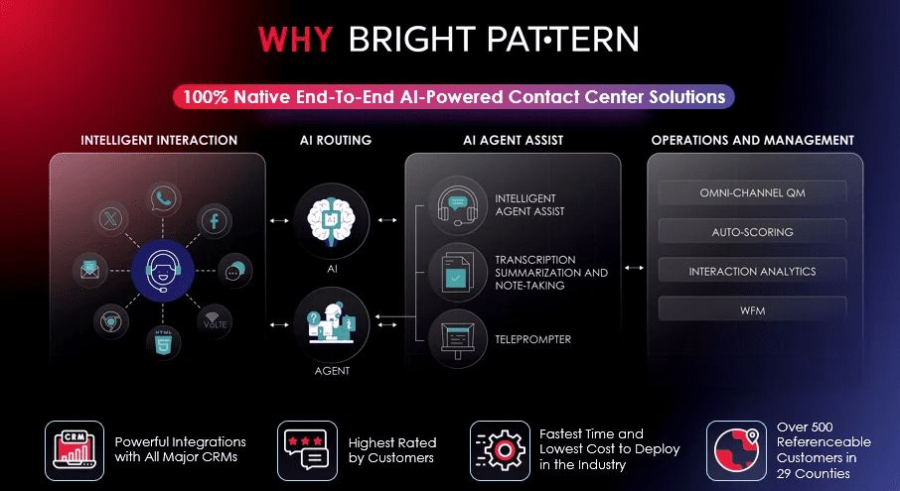
Bright Pattern is trusted across healthcare, finance, retail, and telecommunications for intelligent, automated, and commercially optimized AI call center solutions.
2. Cisco Call Center AI
Cisco provides AI-enabled call center solutions with virtual agents, predictive routing, and real-time analytics. Enterprises can automate routine tasks, optimize staffing, and enhance customer engagement.
3. NICE CXone Call Center AI
NICE CXone combines AI automation, workforce optimization, and real-time coaching to improve agent performance, reduce handling times, and maintain consistent service quality.
4. Vonage Call Center AI
Vonage delivers AI-powered virtual agents, smart IVR, and real-time agent assistance to help businesses automate routine calls and streamline contact center operations.
5. Amazon Connect Call Center AI
Amazon Connect uses AI technologies like Amazon Lex and Contact Lens for virtual agent automation, sentiment detection, speech analytics, and cloud-native enterprise-scale support.
6. Talkdesk Call Center AI
Talkdesk provides AI virtual agents, workflow automation, and real-time agent assistance to improve call resolution speed and optimize agent staffing.
7. Zendesk Call Center AI
Zendesk automates ticket routing, conversational bots, and knowledge base suggestions to reduce agent workload and improve resolution times.
8. Microsoft Dynamics 365 Call Center AI
Microsoft Dynamics 365 delivers AI-assisted call routing, virtual agent support, and predictive insights for personalized, efficient customer service.
9. Salesforce Service Cloud + Einstein Call Center AI
Salesforce Einstein integrates AI into Service Cloud for intelligent routing, workflow automation, predictive recommendations, and real-time agent guidance, improving enterprise efficiency and customer satisfaction.
10. Five9 Call Center AI
Five9 offers AI virtual agents, smart IVR, and real-time agent assistance to automate routine calls and optimize enterprise contact center operations.
The most valuable call center AI use cases (with real-world impact)
AI delivers the best return when it targets high-volume interactions, high-cost workflows, or quality-sensitive moments. Below are widely adopted use cases that translate directly to measurable improvements.
AI-powered self-service (voice and chat)
Conversational AI can handle common requests end-to-end or gather details before handing off to an agent. This can improve customer satisfaction by providing fast answers and can reduce queue pressure during peak times.
High-fit self-service scenarios include:
- Order status checks and delivery updates
- Password resets and account access support
- Appointment scheduling, rescheduling, and confirmations
- Balance checks and simple billing questions
- Policy lookups and basic eligibility questions
A strong self-service design focuses on task completion (not just conversation) and includes a smooth escalation path when customers need a human.
Intelligent routing and prioritization
AI-enhanced routing can interpret intent, urgency, language, and customer context to get people to the best resource faster. The payoff shows up quickly in lower transfers, reduced time to resolution, and better experiences for both customers and agents.
Examples of routing signals include:
- Customer segment (for example, high-value accounts or members with premium support)
- Detected intent (billing dispute vs. product setup)
- Sentiment or urgency cues (to prioritize at-risk interactions)
- Agent skill match (language, product expertise, compliance certification)
Real-time agent assist and next-best action
Agent assist tools listen (or read) in real time, then recommend relevant knowledge articles, troubleshooting steps, and compliant language. This is especially powerful in environments where agents must balance speed with policy accuracy.
Key benefits include:
- Less searching across multiple systems during a call
- More accurate answers when knowledge is surfaced contextually
- More consistent compliance with suggested disclosures and approved phrasing
Automated call summaries and after-call work
After-call work is a major driver of handle time and agent fatigue. AI-generated summaries can capture the reason for contact, steps taken, resolutions, and follow-ups. When integrated well, summaries can also populate CRM fields and create tickets with structured details.
This supports:
- Shorter wrap-up time
- More complete documentation
- Smoother handoffs between teams
- Better continuity for repeat contacts
Conversation analytics for coaching and quality assurance
Traditional quality programs review a small fraction of calls. AI can help teams analyze a far larger share of interactions to detect patterns, highlight coaching opportunities, and identify drivers of customer dissatisfaction.
Common analytics outputs include:
- Top contact reasons and emerging issues
- Script adherence and required disclosure coverage
- Sentiment trends and escalation triggers
- Resolution effectiveness and recontact risk
Proactive support and outbound assistance
AI can help identify customers who may need help before they contact you, based on behavior signals or service events. Proactive messages can reduce inbound volume and improve satisfaction by preventing problems.
Examples include:
- Proactive outage notifications and estimated restoration times
- Delivery exceptions with updated options
- Guided onboarding sequences for new customers
Where call center AI delivers the biggest ROI
While AI can improve many parts of the contact center, the most consistent ROI comes from targeting high-frequency workflows and high-cost friction points. The table below maps common objectives to AI capabilities and measurable outcomes.
| Business objective | AI capability | What improves | How you measure it |
|---|---|---|---|
| Reduce wait times | Self-service, smart routing | Faster access to help | ASA, abandonment rate, queue time |
| Lower handle time | Agent assist, summaries | Less searching and wrap-up | AHT, ACW time, time-to-note completion |
| Improve first-contact resolution | Knowledge surfacing, next-best action | Better guidance and accuracy | FCR, repeat contact rate, transfer rate |
| Increase sales conversions | Real-time prompts, intent detection | Better offers and discovery | Conversion rate, revenue per call, attach rate |
| Strengthen quality and compliance | Conversation analytics, scripted guidance | More consistent delivery | QA score, compliance flags, dispute rate |
| Reduce churn | Sentiment detection, proactive outreach | Earlier intervention | Retention rate, save rate, NPS or CSAT |
Call center AI success factors: what makes adoption work
The best AI programs align technology with clear operational design. The aim is to improve outcomes within your existing workflows, not to bolt on tools that agents must fight against.
Start with a well-defined use case and success metric
Pick a narrow initial problem such as reducing after-call work, improving FCR for a specific queue, or boosting self-service completion for one task. Tie it to a small set of metrics and baseline them before launch.
Use knowledge that is accurate, structured, and easy to maintain
AI agent assist is only as strong as the information it can access. If your knowledge base is outdated or scattered across documents, tickets, and informal notes, invest in cleanup. A smaller, high-quality knowledge set often performs better than a larger, messy one.
Design human handoffs that feel seamless
When AI cannot fully solve an issue, escalation must be effortless. High-performing handoffs share context, reduce repetition, and route to the right agent skill. Customers should feel like the experience is continuous, not like they are starting over.
Make AI adoption easy for agents
Agents embrace AI when it saves time, reduces stress, and helps them succeed. Practical design choices include:
- Clear, scannable recommendations (not overwhelming walls of text)
- One-click insertion of suggested responses
- Editable drafts so agents remain in control
- Transparent cues for why a suggestion appeared
Train supervisors and QA to coach with AI insights
AI can surface patterns, but leaders turn patterns into performance. Equip supervisors with a simple coaching workflow based on conversation insights, and standardize what “good” looks like for key contact reasons.
A practical rollout roadmap for call center AI
Rolling out call center AI is most successful when it follows a phased approach. Each phase should produce measurable gains and reduce risk by validating assumptions with real interactions.
Phase 1: Discovery and baseline
- Identify top contact reasons by volume and cost
- Map current workflows across channels
- Baseline KPIs (AHT, FCR, CSAT, QA, transfers, ACW)
- Confirm data sources (telephony, CRM, ticketing, knowledge base)
Phase 2: Pilot (target one queue or one task)
- Choose a use case (for example, summaries or a single self-service flow)
- Implement guardrails and escalation logic
- Train a pilot group and gather agent feedback
- Run A/B or holdout comparisons where possible
Phase 3: Expand and optimize
- Extend to additional queues and intents
- Refine prompts, knowledge coverage, and routing rules
- Introduce analytics-led coaching and QA sampling improvements
- Automate more post-call steps once accuracy is proven
Phase 4: Operationalize and scale
- Set governance for knowledge updates and model changes
- Build a continuous improvement cadence (weekly insights, monthly upgrades)
- Align AI metrics with leadership dashboards
- Scale to new channels and languages as needed
Key KPIs to track for call center AI
To keep AI adoption grounded in business value, use a balanced scorecard across efficiency, quality, and experience. Avoid focusing on a single metric in isolation, because improvements in one area can affect another (for example, shorter calls should not reduce resolution quality).
Customer experience metrics
- CSAT (post-contact satisfaction)
- NPS or loyalty indicators (when applicable)
- Customer effort proxies (recontacts, transfers, time to resolution)
- Self-service completion rate and containment rate
Operational efficiency metrics
- AHT (average handle time)
- ACW (after-call work) time
- ASA (average speed of answer)
- Abandonment rate
- Cost per contact
Quality and compliance metrics
- QA score and automated quality trends
- Policy adherence (required disclosures, verification steps)
- Escalation accuracy (right agent, right time)
Agent experience metrics
- Agent satisfaction and engagement pulse surveys
- Time to proficiency for new hires
- Attrition and absenteeism trends
How call center AI supports different industries
Contact center needs vary by industry, but the value pattern is consistent: AI helps deliver faster answers, more reliable processes, and a more scalable support model.
Retail and e-commerce
- Order changes, returns, and delivery updates via self-service
- Agent assist for product details and policy guidance
- Proactive notifications to reduce “where is my order” contacts
Financial services
- Secure authentication workflows and compliant language support
- Analytics to spot drivers of disputes and dissatisfaction
- Consistency for complex product explanations
Healthcare and appointment-based services
- Scheduling and reminders with conversational AI
- Better call summaries for continuity and follow-ups
- Routing that prioritizes urgent requests appropriately
Telecommunications and utilities
- Outage-related self-service and proactive updates
- Troubleshooting guidance for agents
- Trend detection to identify network or service issues early
Building trust: privacy, security, and responsible AI in the contact center
Trust is a competitive advantage in customer service. Strong call center AI programs take privacy and security seriously and design for responsible use from day one.
Protect customer data by design
- Limit access to sensitive data to what is necessary for the use case
- Apply data retention rules aligned with your compliance requirements
- Use role-based access so only authorized teams can view transcripts and analytics
Keep a human in control for high-stakes moments
AI is excellent at accelerating routine work and supporting agents, while humans remain essential for complex decisions, empathy-heavy situations, and exceptions. A strong operating model makes it clear when AI assists and when a human takes over.
Maintain transparency in customer interactions
Customers value clarity. When conversational AI is used, make the experience straightforward: it should be obvious how to reach a human and easy to switch channels when needed.
How to choose call center AI capabilities (a practical checklist)
Selecting the right approach depends on your channels, existing systems, and maturity. Use the checklist below to focus your evaluation on outcomes and operational fit.
Operational fit
- Works across your key channels (voice, chat, email, messaging)
- Supports your routing model and skill groups
- Fits supervisor workflows for coaching and QA
Knowledge and accuracy
- Can use your approved knowledge sources effectively
- Allows easy updates and governance for content changes
- Provides confidence indicators or explainability features where possible
Integration readiness
- Connects with CRM and ticketing processes to reduce duplicate entry
- Supports structured outputs (summaries, dispositions, action items)
- Enables smooth handoffs between AI and agents with context transfer
Measurement and improvement
- Includes dashboards or exports for KPI tracking
- Supports experimentation (pilot groups, testing, iteration)
- Helps identify new automation candidates through analytics
Mini playbook: quick wins you can implement first
If you want fast impact, start with initiatives that reduce agent effort and improve consistency, without requiring a complete channel overhaul.
Quick win 1: Automated call summaries
This often delivers immediate value by shrinking after-call work and improving documentation quality. It is a strong entry point because it supports agents directly and is easy to measure through ACW time.
Quick win 2: Agent assist for top 10 contact reasons
Focus on the most common drivers of volume. Build curated knowledge and guided steps, then measure changes in AHT, FCR, and QA for those intents.
Quick win 3: Smarter routing for high-impact queues
Improve skill matching and reduce transfers in a queue where time and accuracy matter. The benefit typically shows up in fewer handoffs, better resolution speed, and higher CSAT.
What “great” looks like: a modern AI-enabled contact center
A high-performing AI-enabled call center is not one where everything is automated. It is one where customers get answers quickly, agents feel supported, and leaders can see what is happening across the operation in near real time.
- Customers can solve simple tasks instantly through conversational self-service.
- When a human is needed, routing brings the customer to the right agent quickly.
- Agents receive in-the-moment guidance, approved language, and fast knowledge access.
- Post-call work is lightweight because summaries and next steps are automated.
- Quality monitoring scales beyond manual sampling, enabling consistent coaching.
- Insights from conversations feed continuous improvement across products and policies.
Conclusion: call center AI as a growth lever for service teams
Call center AI is a powerful way to deliver faster service, more consistent quality, and a better experience for agents and customers alike. By starting with a focused use case, grounding decisions in measurable KPIs, and scaling through proven phases, organizations can turn AI into a sustainable advantage in customer support and sales.
The most successful teams treat AI as a practical tool: it handles routine work at scale, supports agents during complex moments, and continuously surfaces insights that make service operations smarter over time.
